01
Cloth and weave
We buy unbleached cotton and mulmul from weaving families in Rajasthan and neighbouring Gujarat. The cotton is washed, beaten and sun dried before a single block touches it, so the cloth will not shrink out of shape later.
Our Craft
SHREE RAM ENTERPRISES began in a single room in Benard, Jaipur, buying cloth from handloom weavers and carrying it to the block printers a few kilometres away. That route has not changed.
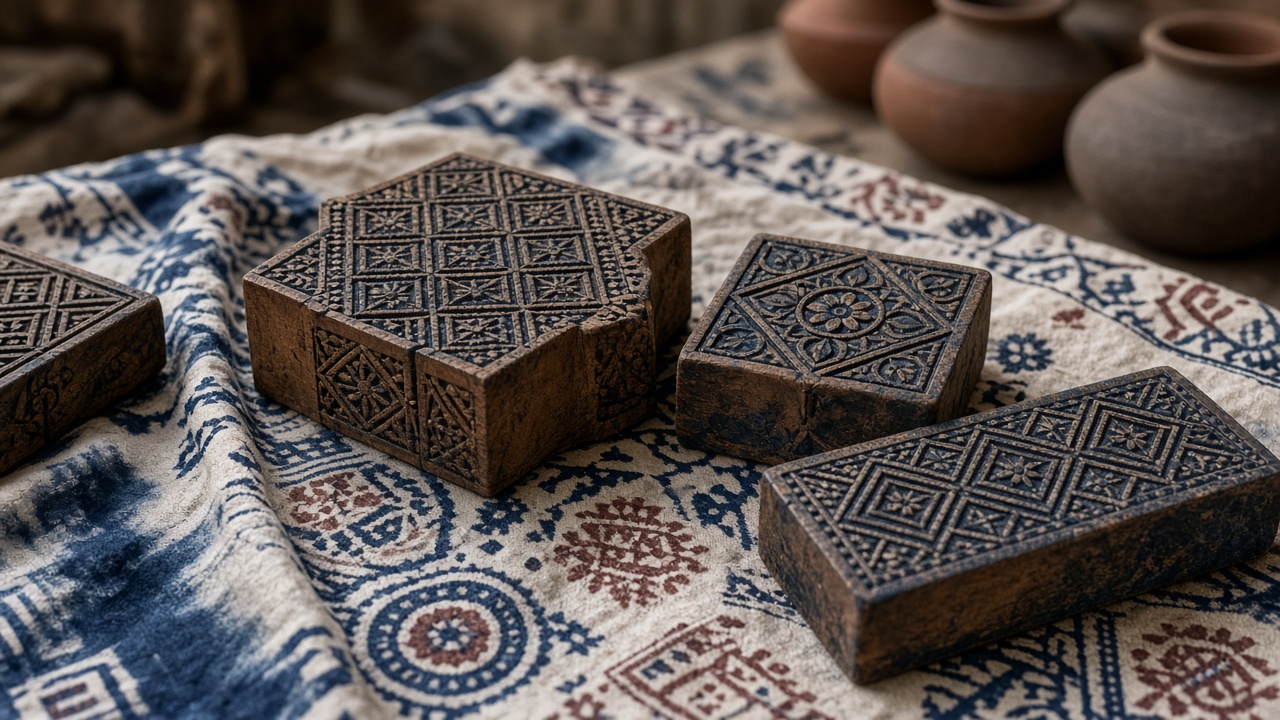
Block printing in Rajasthan is a family trade. The carver cuts the motif into seasoned teak, one block for the outline and one for every colour that follows. The printer lines those blocks up by eye, working down the length of the cloth, striking each block with the heel of the hand so the dye takes evenly. A king size sheet can take several hundred impressions. If you look closely at the borders you will find the places where two impressions meet. That join is not a defect. It is the record of a person at work.
01
We buy unbleached cotton and mulmul from weaving families in Rajasthan and neighbouring Gujarat. The cotton is washed, beaten and sun dried before a single block touches it, so the cloth will not shrink out of shape later.
02
Each design is drawn on paper, transferred to a teak block and cut by hand over several days. Fine motifs are pinned with brass strip instead of carved wood. A block lasts for years and slowly wears, which is why an old print never looks quite like a new one.
03
Sanganeri prints are stamped directly in fine floral repeats. Bagru work is printed over a harda-treated ground. Dabu uses a mud and gum resist pressed through the block, so the covered cloth stays pale when the rest goes into the dye vat.
04
Madder for rust, fermented indigo for blue, pomegranate rind and turmeric for yellows, iron for black. Botanical dyes behave differently in winter and in summer, so no two batches are identical.
05
The printed cloth is washed to release loose dye and laid out to dry in open sun. This is the step that fixes the colour and it cannot be rushed, which is why our print runs pause during the monsoon.
06
Edges are stitched, the sheet is pressed, and every piece is checked against the light before it is folded. Anything with a broken weave or a slipped border is set aside and never sold as first quality.